The Tree Phyllosphere in Urban Environments

Last week the last paper of my phyllosphere project got published at mSystems. It is fair to say that my publishing journey at this journal was, by far, the best yet. Both reviewers gave us great comments and suggestions, which improved the quality of our final work. Trees in urban environments expose their leaves to both chemical contamination and biotic deposition that can come from many unusual sources (i.e. humans, exotic species). This project was aimed to enable comparisons with the more “natural” forest microbiome.

Here is the importance statement we wrote for this project: “In natural forests, tree leaf surfaces host diverse bacterial communities whose structure and composition are primarily driven by host species identity. Tree leaf bacterial diversity has also been shown to influence tree community productivity, a key function of terrestrial ecosystems. However, most urban microbiome studies have focused on the built environment, improving our understanding of indoor microbial communities but leaving much to be understood, especially in the nonbuilt microbiome. Here, we provide the first multiple-species comparison of tree phyllosphere bacterial structures and diversity along a gradient of urban intensity. We demonstrate that urban trees possess characteristic bacterial communities that differ from those seen with trees in nonurban environments, with microbial community structure on trees influenced by host species identity but also by the gradient of urban intensity and by the degree of isolation from other trees. Our results suggest that feedback between human activity and plant microbiomes could shape urban microbiomes.”
F4.large.jpg

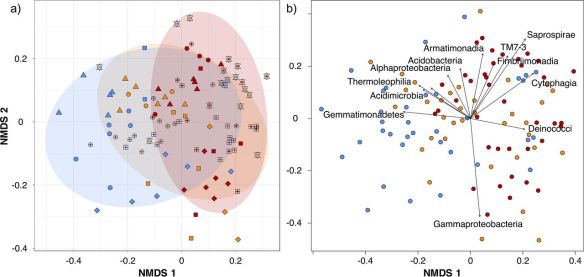
Fig. 4. Nonmetric multidimensional scaling (NMDS) ordination of variation in bacterial community structure of tree phyllosphere along a gradient of urban intensity. Data represent ordination based on Bray-Curtis distances among 108 samples. Samples (points) are colored based on the urban gradient (blue for low intensity, orange for medium intensity, and red for high intensity). In panel a, shapes represent host species identity (squares for Acer platanoides; circles for Acer rubrum; triangles for Acer saccharum; diamonds for Celtis occidentalis; sun crosses for Fraxinus Americana; squares with cross for Fraxinus pennsylvanica; stars for Picea glauca); ellipses indicate 1 standard deviation confidence intervals around samples from urban gradient intensity. In panel b, arrows represent the significant (P < 0.001) correlations between NMDS axes versus the relative abundances of bacterial classes in communities.
Arrieta Lab 2017

Wednesday 13th of July 2017

Lately I have been reflecting on where does my love of science stems from. So far I built this list:

  • Analyzing data
  • Coding (75% == debugging)
  • Reading the papers of others and appreciating the amount of work behind it
  • Spending way too much time making pretty figures
  • Communicating, teaching & sharing my knowledge
  • Lab DNA cuisine

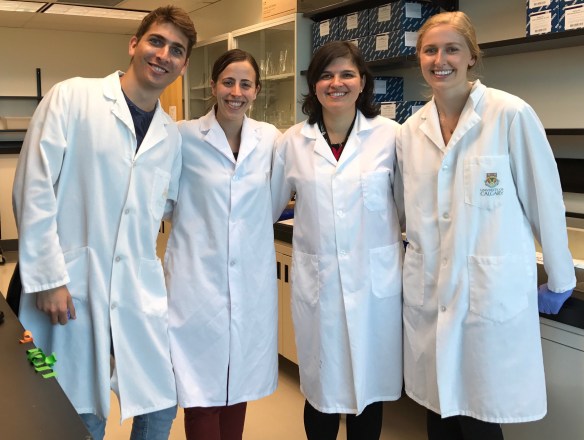
But most of all, getting to meet and work with great human beings. Here is to my new lab in Calgary who have made the last few months a great beginning.

Image

Tale of a First International Conference

As a finishing Ph.D. candidate hoping to find a job in research, establishing work contacts and collaborations across the world is one of my main goals this year.

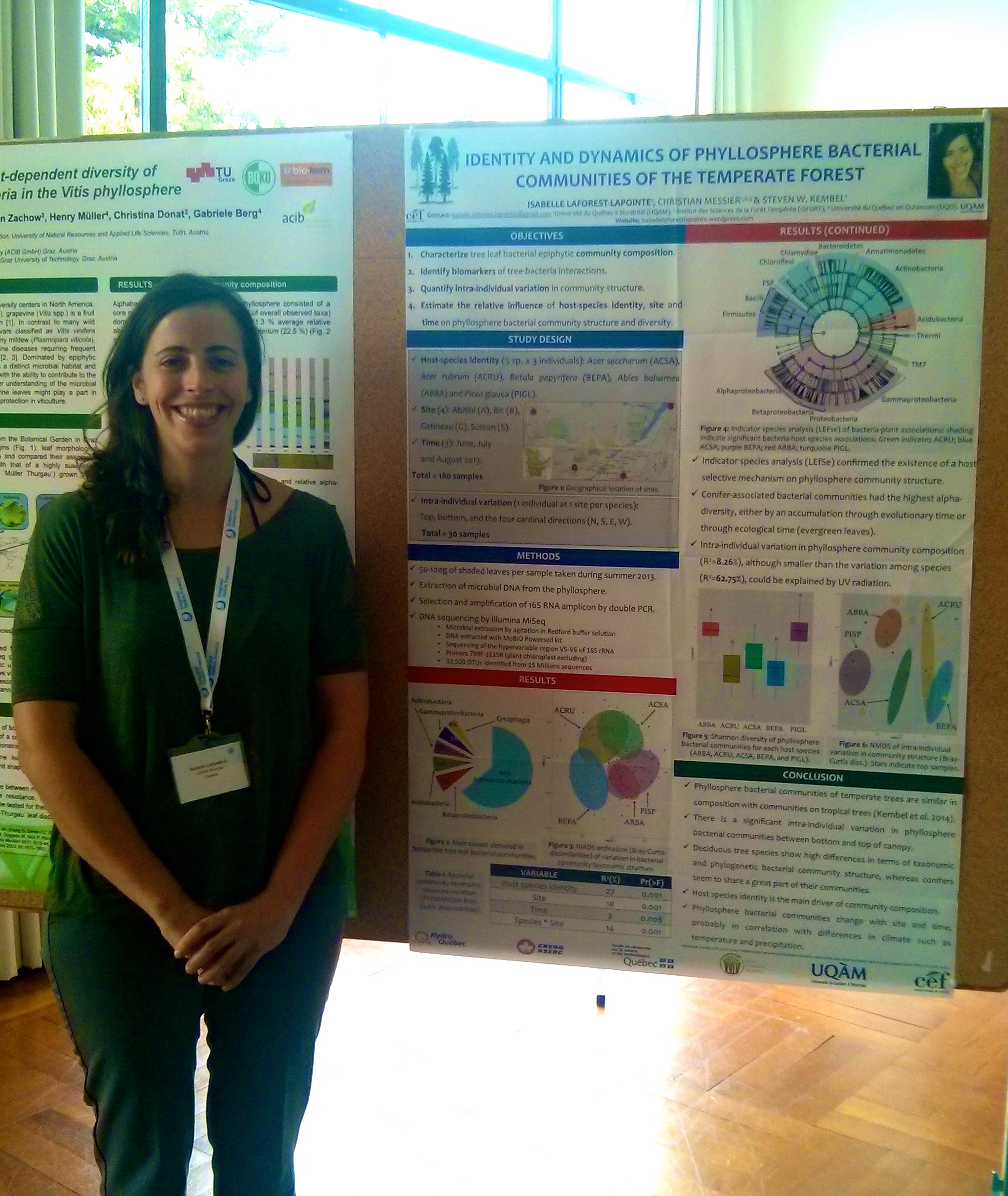
I started 2015 well by spending three months in California and travelling to Oregon and British Colombia. Then this summer I had the chance to go to the 10th International Symposium on Phyllosphere Microbiology (a quinquennial conference directly in my research field) in Switzerland.

Capture d’écran 2015-08-08 à 14.07.36

The meeting was organized by Julia Vorholt (http://www.nature.com/nrmicro/journal/v10/n12/execsumm/nrmicro2910.html), the author of the first paper I read on the Phyllosphere and its complexity. As it was a single-session meeting (everybody listened to the same talk), I got to appreciate the multiple aspects of research on leaf microbiology ranging from abstract physics of microbial presence on leaves to applied techniques for the USDA to control Salmonella infections. Oh and someone in the US is trying to increase rainfall by using Pseudomonas bacteria to trigger droplets formation. Not kidding.

Although much progress has been made in the last five years, there are still so many basic questions that need to be answered. Especially in microbial ecology, since our understanding of communities’ dynamics depends on detection technology and our comprehension of host-bacteria interaction, I feel that we are only looking at the tip of an iceberg. Even if this realization seems challenging, it fuels me to do more and understand better the mechanisms I am looking at.

The 10th International Symposium in Phyllosphere Microbiology was a blast for many reasons:

  • I got to meet great researchers from around the world.
  • I learned an awful lot of things through the four days of conferences.
  • I saw how important it is to work with scientists from different fields (i.e. physics).
  • I got an award for BEST CONTRIBUTION sponsored by ISME for my poster.
  • Switzerland is mesmerizing though very warm.

Hope to see you all in five years!

IMG_20150723_102425