
The Eleven Commandments of Conference and Stress Management

Lucy_Ninja

As the conference season is coming or has already started for Ph.D. students, stress management and slide preparation invade our schedule. So here I give you my best advices for lessening your stress level and achieving the best version possible of your presentation.

  1. PRACTICE: Practice before, and if possible, practice in front of an audience that cares so they can give you feedback. You will be more confident after your test run and the quality of your presentation will be improved by their comments.
  1. RHYTHM: (This one is especially important if you have a dense presentation) Insert a rhythm breaker into your presentation to refocus and recuperate the attention of people that could have gotten lost along the way.
  1. NINJA SLIDES: Imagine what could be the questions someone could ask you and prepare “ninja slides” at the end of your slideshow to support your answer. This will impress your audience and make you look prepared and professional.
  1. AUDIENCE: Know your audience and personalize your presentation to fit their requirements. You will increase your success by hitting the buzzword they want to hear and avoiding spending a lot of time explaining things they know a lot about.
  1. GRAPHS: If you show a graph in your conference, make sure to take the time to explain it’s meaning, the axes and the statistics used. If you don’t plan to explain it don’t show it.
  1. TEXT: Please, you are giving a presentation; not making your audience read your thesis on a big screen. AVOID big sentences, use key words and phrase out loud the theory rather than loading your slides with long pieces of text. Nobody reads them.
  1. WATER: Have a bottle of water with you so you can stop and take a sip. It will give your audience a break and help you to pace yourself.
  1. BREATH: Before the presentation: steady your breath, inspire slowly and keep calm. The first words are always harder, then your voice will steady and you just need to make sure that you will keep breathing!
  1. AAAAAaaaa: Don’t put an “aaaaaaa” sound at each pause between your sentences. It is the most annoying thing in a presentation and shows your lack of control. Just take the time to shape a full sentence and think before talking.
  1. EYE CONTACT: Make sure to make eye contact with your audience, you will be able to see if they are following you or if they are lost and you need to spend more time explaining something. You also engage more with the audience and they are more drawn to your presentation by your energy.
  1. ACCENT: For those of us that don’t speak English as a first language, remember that your accent can get in the way of your presentation and that you need to ARTICULATE and talk SLOWER. It’s already hard to keep focused on a long day of conferences, if your audience can’t understand what you are saying it’s over.

I hope this can be useful to you. What are your advices to give the best presentation?
Going Beyond OTUs

As a graduate student using Next Generation Sequencing Techniques I ask myself 100 technical questions a day on the method to be used, the amount of decisions to take to get robust results is humongous. Usually, when you read recent papers and they all (or almost all) talk about OTUs at 97% similarity, you do the same without thinking. However, I hear more and more concern about the robustness of OTUs as proxies for ecological similarity in bacterial communities. And even more, I noticed that 9 OTUs represent 32,6% in one of our datasets. This raised a red flag for me and needed to be investigated… What are these OTUs and how do they behave across our samples? Damn it, more questions…

OLIGOTYPING

Here for the blog: http://meren.github.io/

Here for the paper: http://onlinelibrary.wiley.com/doi/10.1111/2041-210X.12114/epdf

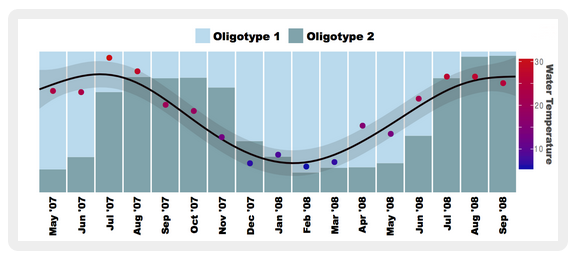
Oligotyping is a “supervised computational method”, based on canonical techniques, that enables researchers to go beyond OTUs and investigate the sub-structure of their sequences in environmental data sets of 16S rRNA gene data. An oligotype is identified by the presence of nucleotides in information-rich (highest Shannon entropy) positions in reads. Therefore, it allows us to structure an OTU into different groups of sequences differing by a single or multiple nucleotides. With these oligotypes, one can test if there are changes in their behavior in samples (species/time/location) and understand better the dynamics of the bacterial communities. Indeed, 97% similarity OTUs could be masking a huge part of bacterial ecology and dynamics across samples and weaken studies conclusions. This is Figure 3a from the Oligotyping paper:

Capture d’écran 2015-04-02 à 10.06.53

SUB-OTU RESOLUTION

Here for the paper: http://www.nature.com/ismej/journal/v9/n1/pdf/ismej2014117a.pdf

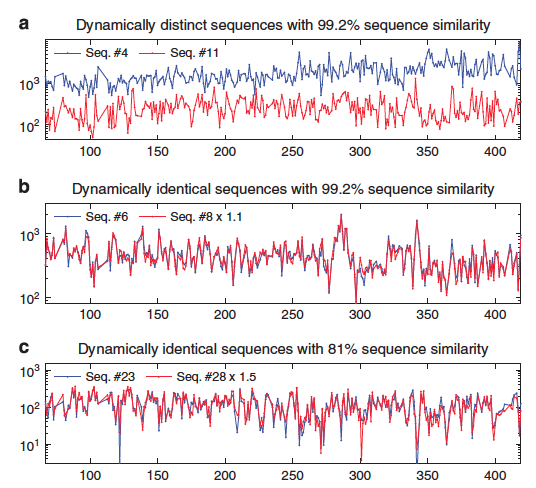
In comparison, there is also this paper from Tikhonov et al. (2015) where they present a clustering-free approach allowing researchers to define sub-OTUs structure into what they call “subpopulations” independently from the similarity of 16S tag sequences. They use time-series to demonstrate that it is possible to structure sub-OTUs groups by combining an error-model-based denoising and systematic cross-sample comparisons. The biggest difference with Oligotyping is that the method is unsupervised, needing no input from the researchers at each step. This method compares the dynamic of pairs of sequences in time through the Pearson correlation of the measured abundance traces (with normalization by maximum possible correlation). As shown by their results, two sequences sharing 100% similarity can behave differently through time (thus one could infer that they belonged to separate ecological population) whereas two sequences at 81% similarity can behave in the identical way. These results suggest that we should not rely only on OTUs to draw understand bacterial community dynamics. This is part of Figure 2 from Tikhonov et al. (2015):

Capture d’écran 2015-04-02 à 10.09.03

CONCLUSIONS

I don’t mean to say that there is no value in looking at OTUs but rather that it appears beneficial to compare the trends seen at the OTU level with those at the sub-OTU level. For my fellow graduate students trying to find their way in analyzing 16S sequences without going crazy, I definitely suggest you read these two papers and consider going beyond OTUs to understand the ongoing dynamics in your samples. Good luck and I hope this was useful to you! Cheers!

Making the Best of a Three Months Internship in the West Coast

2015 started with a professional challenge for me: I was to do a three-months international internship at UC Davis, in Jonathan Eisen’s lab (https://phylogenomics.wordpress.com/). I found the Eisen lab extremely interesting because of their presence on social media and the variety of their projects. Most of their lab members are twitting, writing blogs, creating awesome scientific board games (http://microbe.net/gutcheck/) and they have many outreach and citizen science projects. As I remember leaving Montreal, I was excited but also stressed for the coming change of routine and environment. BUT with challenges come improvement.

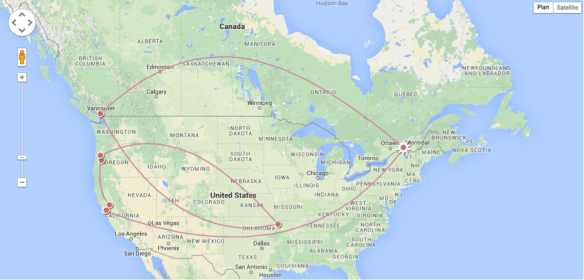
As I aim to be present in the science world for a long time, I am highly conscious that great Science come from collaboration, not only from single researchers doing their own thing. Thus, I planned to take advantage of advance researchers experience and I contacted many different professors related to my field. On my list were:

Untitled

OSU, Oregon:

Thomas Sharpton (http://lab.sharpton.org/)

U. Of Oregon, Oregon:

Jessica Green (http://pages.uoregon.edu/green/)

Brendan Bohannan (http://pages.uoregon.edu/bohannanlab/)

UC Berkeley, California:

Steve Lindow (http://icelab.berkeley.edu/lindow-lab-1)

Paul Fine https://ib.berkeley.edu/labs/fine/Site/home.html)

David Ackerly (http://www.ackerlylab.org/)

Ellen Sims (https://ib.berkeley.edu/people/faculty/simmse)

UC Davis, California

Johan Leveau (http://plantpathology.ucdavis.edu/faculty/Leveau_Johan_HJ/)

Jonathan Eisen (https://phylogenomics.wordpress.com/)

UBC Okanagan Campus, British Colombia

John Klironomos (http://johnklironomos.com/)

This also meant that I would have to cover a lot of ground in a short time. However, the encounters with the PIs and their lab compensated greatly for the traveling length. Meeting great and welcoming human beings all over the west coast of USA and Canada that also happen to do research greatly motivated and inspired me to continue doing my best in my field. There are some crazy inspiring projects out there! It was also reassuring to see that the challenges are mostly the same in every lab, especially when working with Next-Generation Sequencing.

Another of my goals was to help teach two workshops, one given by Titus Brown (http://ged.msu.edu/) at UC Davis on mRNA (http://dib-training.readthedocs.org/en/pub/2015-03-04-mRNAseq-semimodel.html) and a Software Carpentry (http://software-carpentry.org/index.html) workshop at U. of Arkansas. These two workshops were great in the sense that teaching boosted my energy and I got great feedback from our attendees. From the RNA workshop I learned a lot; widened my horizon of knowledge and at the same time met the great Titus Brown while broadcasting my skills (http://ivory.idyll.org/blog/2015-a-first-workshop.html). The great people of Rkansas were absolutely amazing, welcoming and most importantly, truly interested.

So this concludes three months of international internship, visits, workshops, meetings, but more importantly three months of growing my network and creating connections with great people all along the west coast.

I would advise any Ph.D. student to take advantage of the scholarships provided by their University (if there are some) to mix traveling and Science.