LORD OF THE SCHOLARSHIPS: THE QUEST (IN CANADA)

Writing about my Ph.D. experience, I can’t leave by my horrible great story with scholarship demands. Each September, I go through the same loop: I write not really effectively the never-ending list of documents needed to apply for scholarships. Scholarships from my University. From Companies. From banks. From the provincial and federal govern. And this is how I felt when waiting for answers at the beginning of my Ph.D.:

Untitled

Pulling together a great scholarship application is tricky. You need to hit the buzzwords real quick and be solid at all levels. Here are the fields you will usually be judged on:

  • Past grades as an undergraduate or master student
  • Research aptitudes and experiences
  • Project quality (scientific and economical)
  • Social implication, leadership and communication abilities

I applied many times to multiple scholarships and “YES” didn’t come too often my way. Every time I got a “NO”, I felt really disappointed and disgusted at the amount of work put in for nothing.

Untitled1


Time passed. I published a paper. I got more experiences in research and gave plenty of talks everywhere. And then one day, it started raining scholarships on me. Thus, here are my advices on how to vanquish Sauron the scholarship committees:

First, identify clearly what are the points you’ll be judged on for each scholarships.

For your grades:

  • I wish I could go back in the past and make myself work harder to get better grades but since this is not possible… yet… if you are still getting grades, make it count!

For your research aptitudes and experiences:

  • You already know this one: try to publish papers. No surprise here…
  • Get involved in many small research projects with your director or fellow students.
  • Offer to give a hand on ongoing projects so that you can learn from this and add it to your curriculum.
  • If you can be the manager of a small intern team during sampling season, this adds definitely to your attractiveness!

For your project:

  • Sadly, these days, scholarships goes with profit, for someone, somewhere. So identify the economical attractiveness of your project and make sure that you make it pop.
  • Make it short, clear, and sound.
  • Identify clearly WHY someone should study that. If you are not able to sell your project and make it sexy, you ain’t trying hard enough.

For your social implication:

  • Get involved in organizations around you. The key here is to find the right amount of time to give. Give too much and it will lessen the energy you’ll have to give on your project.
  • Offer to give conferences at citizen meetings or in schools. This will make you practice your synthesis skills and will improve your quality as a speaker.
  • Use any opportunity to give talks at national or international meetings close-by.

For all your application:

  • Find yourself a good friend (from outside your field of research), that knows you well, and go through your application together. This person will help you proofread your text and can tell you if your project is clear. This person will also be key to add activities or experiences to your curriculum that you could have forgotten.

Armed with all these advices, you can now feel like that when sending your application next fall. Good luck!


 Untitled3

ONE MORE QUESTION: WHAT ABOUT THE “RARE” OTUs?

As I am going through my Ph.D., I cannot stress enough the importance of having a critical mind and using it often.

Can't stop thinking cartoon

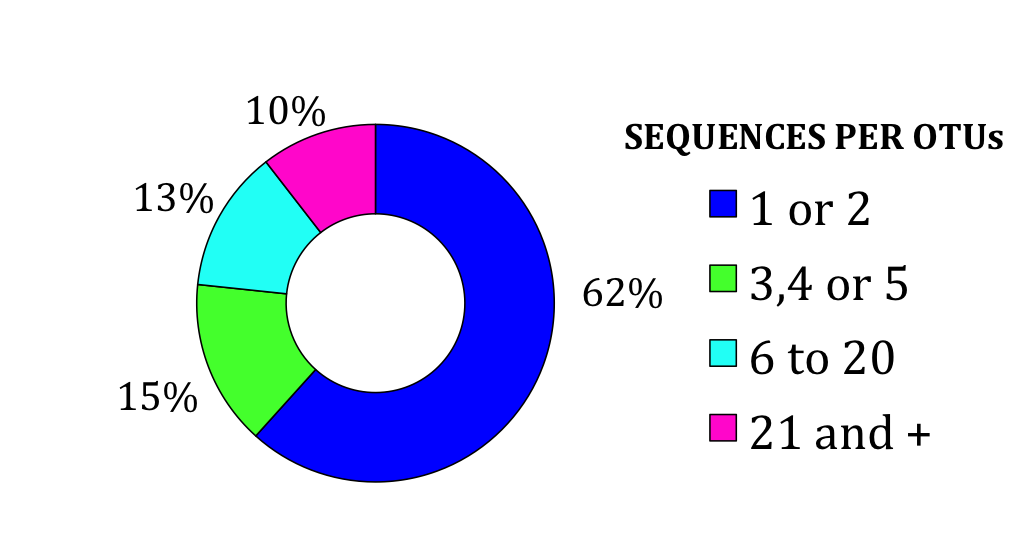
When analyzing a database of 15 Millions of 16S sequences, I arrived to the point where I had picked OTUs (Operational Taxonomic Unit) and got an impressively high number (45580) from which 28113 were represented by singletons (present once) or doubletons (present twice). More then half of my bacterial community from 200 samples relied on the presence of one or two sequences. It made me think about these “rare” sequences, their significance and reliability.

Untitled

SOURCES OF ERRORS

Although they are getting sexier and cheaper every day, the next-gen. sequencing techniques are not free of errors (see Schloss et al. 2011 for strategies to reduce them). Indeed, many sequences might be the result of PCR bias or sequencing errors and therefore be misleadingly assigned as a unique OTU afterwards. Our lack of knowledge on environmental bacterial communities reduces further our ability to distinguish between real “rare” sequences and errors/artifacts. The presence of these artifacts adds another challenge to the already technical task of analyzing high-throughput sequencing datasets.

Untitled

Agreeing with Zhan et al. (2014), I found that filtering processes had more influence on low abundance OTUs. Indeed, quality and chimera filtering removed most of the sequences that were unique from my database (excluding 66% of singletons, doubletons, and tripletons). Another thing to think about is the 16S copy number in one bacterial cell. As shown by Lee et al. (2009) and Rastogi et al. (2009), it is highly common that one cell will hold multiple copies of the 16S sequence (see Kembel et al. 2012 for techniques to control for it). Therefore, to find only one copy of that sequence even through a cell holds multiple version of that amplicon makes me doubt the value of such “rare” sequence. And knowing about the flaws of OTU picking, I am eager to see some new techniques that minimize clustering errors or noise.

Should one consider excluding rare OTUs (singletons, doubletons, tripletons, etc.) from their community analysis? And where to stop the cut?

THUS WHAT THE HELL SHOULD I DO?

Although being more stringent with your database impedes you to study the “rare” members of the bacterial communities, I personally prefer to be overly strict (and miss some OTUs) than be overly negligent (and draw false conclusions). Additionally, one must consider his study’s objectives when deciding what to do with the “rare” sequences. You should be extremely careful when using statistical analyses or estimators that are sensitive to the presence of “rare” sequences. For example, diversity will definitely be over-inflated by the “rare” OTUs (Kunin et al. 2010; Bokulich et al. 2013). A strategy could be to use multiple thresholds of sequence number to accept an OTU as real and then repeat your analyses to see if the results change. In conclusion, although it is tempting to try to study the “rare” microbiome, it remains a hard challenge to distinguish between sequencing artifacts and real “rare” sequences.


REFERENCES

Bokulich NA, Subramanian S, Faith JJ, Gevers D, Gordon JI, et al. (2013) Quality-filtering vastly improves diversity estimates from Illumina amplicon sequencing. Nat Meth 10: 57–59. doi: 10.1038/nmeth.2276

Kembel, S. W., Wu, M., Eisen, J. A., & Green, J. L. (2012). Incorporating 16S gene copy number information improves estimates of microbial diversity and abundance. PLoS computational biology, 8(10), e1002743.

Kunin V, Engelbrektson A, Ochman H, Hugenholtz P (2010) Wrinkles in the rare biosphere: pyrosequencing errors can lead to artificial inflation of diversity estimates. Environ Microbiol 12: 118–123. doi: 10.1111/j.1462-2920.2009.02051.x

Lee ZM-P, Bussema C, Schmidt TM (2009) rrnDB: documenting the number of rRNA and tRNA genes in bacteria and archaea. Nucleic Acids Res 37: D489–93 doi:10.1093/nar/gkn689.

Rastogi R, Wu M, DasGupta I, Fox GE (2009) Visualization of ribosomal RNA operon copy number distribution. BMC Microbiol 9: 208 doi:10.1186/1471-2180-9-208.

Schloss, P. D., Gevers, D., & Westcott, S. L. (2011). Reducing the effects of PCR amplification and sequencing artifacts on 16S rRNA-based studies. PloS one, 6(12), e27310.

Zhan, A., Xiong, W., He, S., & MacIsaac, H. J. (2014). Influence of artifact removal on rare species recovery in natural complex communities using high-throughput sequencing. PloS one, 9(5), e96928.