
- “Now this is not the end.
- It is not even the beginning of the end.
- But it is, perhaps, the end of the beginning.“
- Sir Winston Churchill, 1942
Yesterday, 24th of May 2017, the third chapter of my thesis got published in Nature: read it! It is so incredible that I didn’t believe it until I saw it on the website…
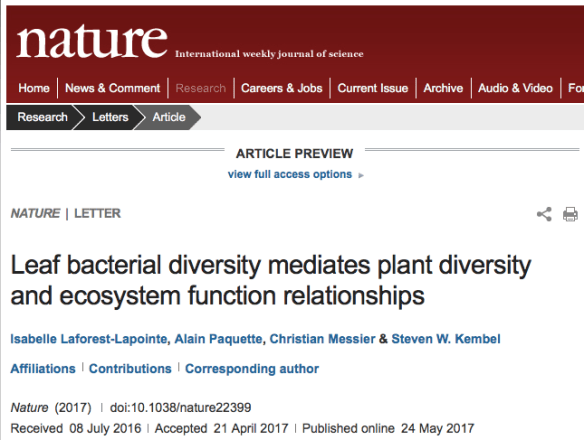
Here’s a synthesis:
As recent researches have demonstrated that microbes are crucial actors of human health, microbial organisms could also play a similar role for plants, driving key functions such as productivity. The work of Laforest-Lapointe et al. provides the first evidence that the diversity of microbes on tree leaves influences positively tree community productivity, a finding that has critical implication for forestry and agriculture, as well as for future fundamental research on microbial ecology.
Plant diversity is known to play a crucial role in the functioning of terrestrial ecosystems. Plant ecosystem productivity (the biomass produced by a community of plants) is a key ecosystem function both in natural ecosystems as well as in agriculture and forestry. The productivity of an ecosystem increases when a higher diversity of plants is present in the community. Previously, this correlation between productivity and diversity was attributed to the fact that when more species with different ecological niches are present in a community, the resources available in an ecosystem will be more fully utilized, leading to increased overall productivity. Recent advances in DNA sequencing technology have revealed the incredible diversity of microorganisms living on and in plant tissues – the plant “microbiome” – the combined genetic material of microorganisms living on plants. These plant-associated microbes can have important effects on the growth and health of individual plants, but their importance for ecosystem function is not well understood. In this study, Dr. Isabelle Laforest-Lapointe and colleagues demonstrate that the bacteria living on tree leaves can also influence ecosystem productivity, even after accounting for the role of plant diversity. The research team, including Isabelle Laforest-Lapointe (UQAM), Alain Paquette (UQAM), Christian Messier (UQAM/UQO) and Steven Kembel (UQAM) measured and quantified the diversity of bacteria living on tree leaves in a biodiversity experiment with trees (IDENT) established near Montréal, Canada, where trees were planted in different combinations of species diversity and functional diversity and the productivity of these tree communities was measured after several years of growth. Through sequencing of bacterial barcode genes, the research team quantified the number of different bacterial taxa living on each tree. The principal finding of this study was that tree communities whose leaves host a more diverse set of bacterial taxa were more productive, producing more biomass even after accounting for the importance of plant diversity. This discovery suggests that the plant microbiome could play a key role in terrestrial ecosystem productivity, and that models of the relationship between plant diversity and ecosystem productivity could be extended by adding information on the microbial communities associated with plants. The study also demonstrated that plant diversity influences microbial diversity on leaves, with each tree species possessing a distinctive bacterial community, and with trees growing amongst a diverse set of neighbour trees tending to have a higher diversity of bacteria on their leaves than trees growing among trees from the same species. This study suggests that leaf microbiome diversity could play a key role for terrestrial ecosystem productivity, a discovery having multiple potential beneficial consequences in agriculture and forestry, as well as for fundamental research on the roles of multitrophic networks in terrestrial ecosystems and the theories that attempt to explain relationships between biodiversity and ecosystem function.
Now I am not a Ph.D. student anymore. Today marks the day of my first pay as a Postdoctoral fellow at the University of Calgary, Cumming School of Medicine, Depts. of Physiology and Pharmacology & Pediatrics, under the supervision of the excellent Dr. Marie-Claire Arrieta.
From working on microbes inhabiting the leaves of trees, I will now be looking at samples of infant intestinal microbes or mice microbes! Poop it is!









 On the other end, diversifying our domains of skills is expensive in time, energy and in memory space (if only we could have more than one brain…). The generalist might always feel like he needs to improve at all levels, that he is not THE best at anything. However, the generalist becomes highly independent, needing only inputs from experts once in a while, and he is never “out of the game” when the conditions change. In the long term, being a generalist is safer since he will always have a base to build on.